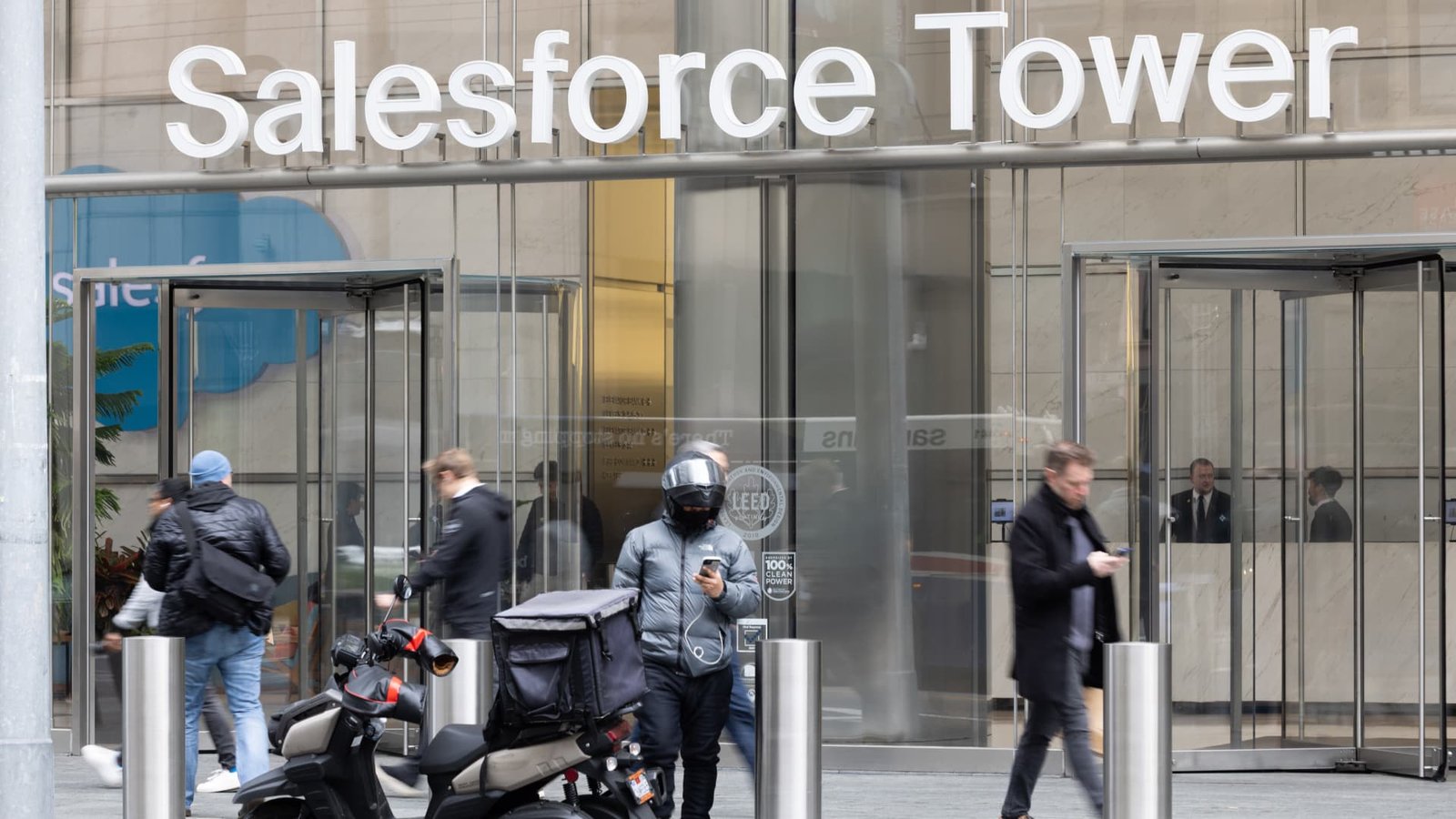
Every weekday, CNBC Investing Club with Jim Cramer publishes Homestretch – an actionable afternoon update just in time for the final hour of trading on Wall Street. The market is mixed on Friday as Wall Street wraps up another volatile week. The blue-chip Dow Jones Industrial Average index gained nearly 200 points, or 0.4%, while the S&P 500 was roughly flat. The tech-heavy Nasdaq is the laggard, falling about 0.5% thanks to additional weakness in semiconductor stocks. After an incredible second quarter for chipmakers, July was a very different story as the market questions the sustainability of artificial intelligence expansion. Micron slipped over 7%, Sandisk fell over 10% and Marvell Technology fell 7%. In our portfolio, shares of club name Intel fell nearly 6% on Thursday evening, despite its strong second-quarter results. As we noted in Friday’s morning session, we would buy this decline in the Intel position if it weren’t for our restrictions (which prevent us from trading any stock that Jim Cramer mentions on TV for 72 hours). However, we reduced our Starbucks position and bought more FedEx Freight. A standout technology group on Friday is software – not exactly a surprise given the weakness in hardware. We’ve seen this pattern several times recently: sell the hardware winners, buy the beaten-down software names. The money does not necessarily leave the market en masse, but is reallocated. The club name Salesforce was among our top performers on Friday, while Workday, Intuit and Adobe also delivered strong days. More about the software in a moment. Rising oil prices have been a headwind for stocks this week, but at least we’re seeing some relief on Friday. U.S. light oil WTI and international Brent crude fell after Reuters reported that Pakistan was pushing for another round of peace talks between the U.S. and Iran. We’ve seen a lot of headlines like this over the course of the nearly five-month Middle East conflict, so we don’t want to put too much emphasis on any one report. And as we saw this month, even agreeing to a tentative peace deal doesn’t mean it won’t soon fail. Of course, we cannot ignore the impact of elevated oil prices on bond yields, Federal Reserve policy, and the global economy at large. But we also know we can’t day trade the headlines, so we don’t try. Traders are also grappling with President Donald Trump’s renewal of his tariff campaign, threatening a “significant” round of levies on the European Union over the bloc’s treatment of American tech giants. Earlier on Friday, the Trump administration imposed new tariffs on 60 trading partners, citing alleged forced labor in global supply chains. Now back to the software. Salesforce shares rose more than 4% on Friday after the company announced it received a three-year, $1.6 billion contract from the U.S. Department of Veterans Affairs. The agreement provides VA employees with agent-based AI-based tools aimed at improving efficiency. Salesforce is seeing a surge in government business, announcing in its earnings release in May that annual recurring revenue (ARR) on its public sector cloud exceeded $2 billion for the first time ever. That was 23% more than in the previous year. Gil Luria, an analyst at DA Davidson, told us that the new contract appears to be “significant” given its size and the importance of the Department of Veterans Affairs. However, he cautioned that “a single deal does not change the fact that Salesforce has struggled to sustain its growth in recent years.” He added: “It is also worth noting that participating in a large government deal is not always a guarantee of significant profits.” While Salesforce shares have risen more than 6% in the last month, they are still down nearly 40% in 2026. The stock has come under heavy pressure on fears that AI could undermine its seat-based enterprise software model. CEO Marc Benioff has repeatedly pushed back against the narrative, but Wall Street doesn’t believe him. We will continue to hold on to the few stocks we still own and give Benioff some time to turn things around based on past successes. Next week is the busiest of the summer earnings season, with about a third of the S&P 500 expected to report. Within the portfolio, Corning and Boeing report on Tuesday, Procter & Gamble, Meta Platforms, Microsoft and Starbucks on Wednesday, Apple and Amazon on Thursday and Eaton and Linde on Friday. We’ll take a closer look at all of these upcoming reports, along with consensus earnings and revenue estimates, in our usual “Week Ahead” column, published on Sunday. Other notable companies set to report next week include Coca-Cola, Qualcomm, Arm Holdings, Seagate, Chipotle, Yum, Visa and Mastercard, Bristol Myers, UPS and Robinhood. There is also an announcement of a FOMC meeting on Wednesday and it is becoming increasingly uncertain whether the Fed will raise interest rates or leave them unchanged at its next meetings. (A complete list of Jim Cramer’s Charitable Trust stocks can be found here.) As a subscriber to CNBC Investing Club with Jim Cramer, you will receive a trade alert before Jim makes a trade. Jim waits 45 minutes after sending a trade alert before buying or selling a stock in his charitable foundation’s portfolio. If Jim discussed a stock on CNBC television, he waits 72 hours after the trade alert is issued before executing the trade. THE INVESTING CLUB INFORMATION SET FORTH ABOVE IS SUBJECT TO OUR TERMS AND CONDITIONS AND PRIVACY POLICY, ALONG WITH OUR DISCLAIMER. THERE IS NO fiduciary obligation or duty IN RECEIVING YOUR INFORMATION PROVIDED IN CONNECTION WITH THE INVESTING CLUB. NO SPECIFIC RESULTS OR PROFITS ARE GUARANTEED.
https://www.cnbc.com/2026/07/24/the-sell-chips-buy-software-trade-reappears-as-wall-street-caps-off-another-volatile-week.html
- International student shares how she got a Google job adapted for AI
- AI for Peace: In Rome, Nobel Prize winners call for the disarmament of AI and nuclear weapons
- Meet the billionaires behind $336 million in the California election
- Whatley reaches out to dozens of WNC supporters as money pours into crucial Senate race
