

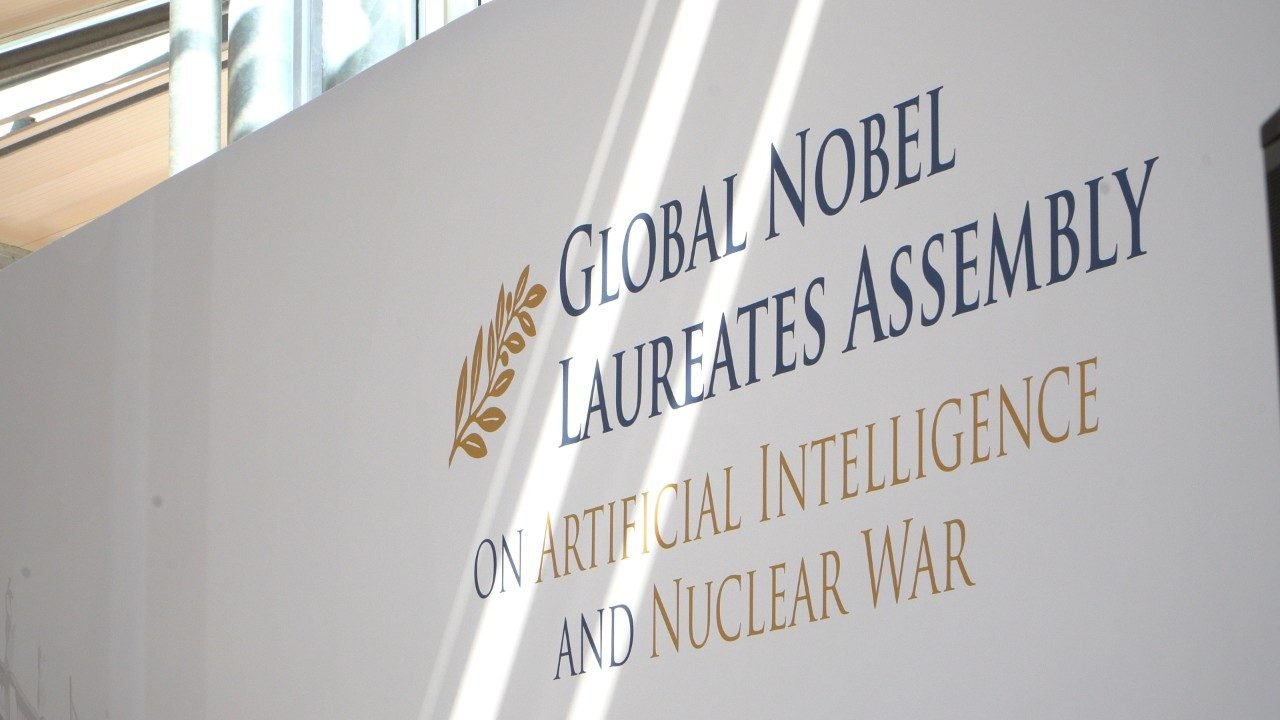
The first day of the Global Nobel Laureates Assembly on Artificial Intelligence and Nuclear War begins on July 14 at Borgo Laudato Si’ in Castel Gandolfo and invites Nobel laureates, experts, university representatives and more to reflect on the greatest challenges facing our world.
By Isabella H. de Carvalho
Over 200 Nobel Prize winners, former heads of state, university representatives and experts gathered among the pine trees and olive groves of the Papal Gardens in Castel Gandolfo on Tuesday, July 14, to discuss artificial intelligence and nuclear war.
It was the first day of the Global Nobel Laureates Assembly on Artificial Intelligence and Nuclear War, which will last until Thursday July 16 and is inspired by Pope Leo XIV’s encyclical: Great humanityto protect the human person in the age of artificial intelligence.

Participants of the Global Nobel Laureates Assembly on Artificial Intelligence and Nuclear War
The highlight of the Assembly will be the signing of the Rome Declaration on an unarmed and disarmed peace in the age of artificial intelligence, nuclear and autonomous weapons, new digital protocols and new models of digital development. The aim is to present guiding principles for the governance of AI that are focused on cooperation, human dignity, holistic development and peace.
The three-day event will feature panels on topics such as “The Fragility of the Human Family in the Nuclear Age,” “Technology in the Service of Humanity,” and “The Moral Challenges of AI and War.”
The first two days of the meeting will take place in Borgo Laudato Si’ (“Village Laudato Si’”) in the Papal Gardens in Castel Gandolfo, while the third and final day of the event will take place at the Capitoline Hill, seat of the Municipality of Rome.

Thirty Nobel Prize winners, representatives from 30 countries, former heads of state and government, 20 leading experts in artificial intelligence – including OpenAI, Google DeepMind, …
Table of Contents
The need for common principles at this moment in history
“We come together at a time in history marked by deepening geopolitical tensions, the fragmentation of the international order and intensifying technological competition,” said Cardinal Fabio Baggio, Pro-Prefect of the Dicastery for Promoting Integral Human Development and Director General of the Center for Higher Education at Borgo Laudato Si’, in his opening remarks. He highlighted how these issues come with the rapid development of AI and autonomous technologies.

Cardinal Baggio during his speech
In this context, he emphasized the importance of this meeting and promoting dialogue in various areas. “At a time when the pace of innovation often exceeds that of reflection, the world needs shared principles that can guide progress toward authentically human goals,” he said.
“This gathering is not just gathering to analyze risks,” emphasized Cardinal Silvano Maria Tomasi, president of the Domus Communis Foundation, who is taking part in the event, in his address.
“They have come together to renew hope, to show that dialogue is still possible, that wisdom can still go hand in hand with knowledge, and that humanity has not lost the ability to determine its own future.”
“May future generations be able to say that at a moment when humanity possessed unprecedented power over its own destiny, women and men of conscience chose cooperation over confrontation, dialogue over fear, and hope over resignation,” he emphasized.

Cardinal Tomasi
The need to govern AI
The opening session revolved around the topic “Great humanity “For the future of our common home,” as many of the discussions are inspired by Pope Leo XIV’s first encyclical, published in May.
The session began with an address by Cardinal Ángel Fernández Artime, pro-prefect of the Dicastery for Institutes of Consecrated Life, who gave an overview of the Pope’s text.

Cardinal Artime gives his speech
Several well-known speakers then took the floor, including Juan Manuel Santos, Nobel Peace Prize winner and former President of Colombia, who welcomed the invitation of Pope Leo XIV Great humanity to disarm AI, noting that “only by acting in a similar spirit can we hope to overcome all of the existential threats facing humanity.”
He stressed: “Without effective governance, it will be difficult, even impossible, to ensure that AI becomes a force for good guided by human dignity, responsibility, accountability and the rule of law.”

Professor Muhammad Yunus, Nobel Peace Prize winner and Chief Adviser Emeritus of Bangladesh
In his address, Professor Muhammad Yunus, Nobel Peace Prize winner and Chief Adviser Emeritus of Bangladesh, instead emphasized how we are living through the end of one civilization and the beginning of the next, and the importance of involving young people in shaping the world’s future.
Other speakers at this session included Dr. Agnès Callamard, Secretary General of Amnesty International; Dr. Amir Banifatemi, founder and board member of the International Association for Safe and Ethical AI; Professor James Muller, co-founder of International Physicians for the Prevention of Nuclear War (Nobel Peace Laureate Organization, 1985); Professor Karen Hallberg, Secretary General of the Pugwash Conferences (Nobel Peace Laureate Organization, 1995); and Professor David Gross, Nobel Prize winner in physics and Chancellor’s Chair Professor at the University of California, Santa Barbara.
The rest of the morning and afternoon was dominated by several rounds of discussions on topics such as when AI escapes human control. Several speakers gave speeches, including Maria Ressa, Nobel Peace Prize winner and co-founder and CEO of Rappler, as well as AI researchers from institutions such as the Anthropic Institute and DeepMind, who offered different perspectives on the topics.
Watch our interview with Maria Ressa
https://www.vaticannews.va/en/vatican-city/news/2026-07/nobel-prize-experts-nuclear-war-artificial-intelligence-assembly.html
