

The National Science Foundation (NSF) has awarded Northwestern University $20 million over four years to create the nation’s first publicly accessible, AI-powered protein engineering cloud lab.
Called the AI-Driven, Rapid, Experimental Automation Machine (DREAM) Cloud Lab, this facility is intended to become a national resource to dramatically accelerate the development of new medicines, sustainable materials, agricultural technologies and other biotechnological innovations.
The facility is among the first 20 NSF-funded Programmable Cloud Laboratory (PCL) testbeds established to create a nationwide network of AI-enabled, remotely accessible laboratories. Instead of requiring researchers to purchase and maintain expensive, sophisticated scientific equipment for their own laboratories, the network will enable scientists to program experiments remotely, access cutting-edge instruments, and accelerate discoveries through shared data and AI tools.
Positioned within Northwestern’s Center for Synthetic Biology (CSB), DREAM will act as a protein engineering hub within the broader PCL network, sharing data, AI models, and best practices with other cloud laboratory nodes while enabling collaboration across scientific disciplines.
“Northwestern is honored to be selected by NSF to host one of the first Programmable Cloud Laboratory testbeds in the country,” said President Mung Chiang. “DREAM is an important initiative that will create the platform for our Center for Synthetic Biology to collaborate with researchers across the country and advance important breakthroughs in protein engineering and biotechnology more broadly. This award is not only financial but also strategic and once again reflects the caliber and ambition of the Northwest’s research leaders.”
“This funding recognizes Northwestern’s longstanding leadership at the intersection of engineering, AI and biology,” said Chris Schuh, dean of the McCormick School of Engineering. “This investment is a milestone not only for the university, but also for the rapidly growing biotechnology ecosystem in Chicago and Illinois.”
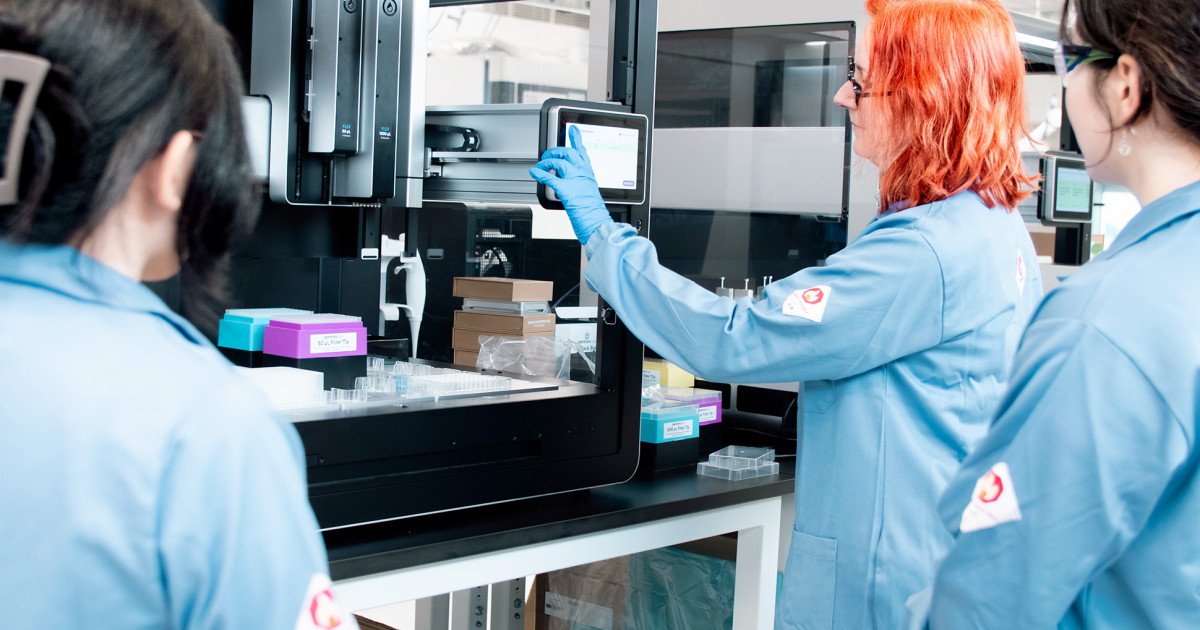
DREAM will be physically housed in CSB’s Synthetic Biology Foundry, a joint research facility equipped with advanced robotics and protein engineering tools. The Synthetic Biology Foundry is co-located with the Querrey InQbation Lab, Northwestern’s startup incubator center, allowing breakthrough research to quickly transition from the lab into new companies and products.
“DREAM will positively transform our society, create new companies and create new jobs by accelerating new technologies for manufacturing, critical mineral mining, healthy aging, agriculture and advanced materials,” said Julius B. Lucks of Northwestern, DREAM’s principal investigator (PI). “Building DREAM at the Northwestern Center for Synthetic Biology will allow us to integrate our approaches to responsible innovation, strengthen our regional biotech ecosystem, and serve the entire country as a hub for transformative science and engineering that benefits everyone.”
Lucks is the Margery Claire Carlson Professor of Chemical and Biological Engineering at McCormick University and co-director of the Center for Synthetic Biology. DREAM’s co-PIs are Danielle Tullman-Ercek, James N. and Nancy J. Farley Professor of Manufacturing and Entrepreneurship, professor of chemical and biological engineering at McCormick University and co-director of the Center for Synthetic Biology; Han Liu, Orrington Lunt Professor of Computer Science at McCormick University and Professor of Statistics at the Weinberg College of Arts and Sciences; and Michael Jewett, professor of bioengineering and chemical engineering at Stanford University. Key people include Joshua Leonard, professor of chemical and biological engineering at McCormick University, and Michelle Hoffmann, executive director of the Chicago Biomedical Consortium.
Table of Contents
Power of protein engineering
Proteins perform almost every vital function. Scientists are increasingly trying to engineer proteins for a wide range of applications, including developing new therapeutics, recycling plastics, detecting environmental pollutants, and recovering important minerals. Nevertheless, developing proteins that can perform exactly the desired function remains slow, expensive, and accessible to relatively few laboratories.
Although recent advances in AI allow scientists to use computation to design promising proteins, they still face a critical bottleneck. Scientists need to build and test proteins to generate the data needed to improve AI models. DREAM was designed to eliminate this bottleneck.
Through a cloud-based interface, users specify the desired functions for a protein to perform. AI models will then suggest promising designs and – after evaluation and approval through a rigorous biosafety and biosecurity review process – robotic systems will automatically build and test these proteins. The resulting experimental data will continually improve the AI models. The testbed will integrate perspectives from an Ethics and Responsible Innovation Board to ensure the entire system creates a design-build-test-learn cycle that quickly refines proteins to safely meet users’ goals.
“Building and testing the proteins have historically been lengthy, slow and expensive steps,” Tullman-Ercek said. “To solve this problem, the DREAM facility is leveraging cutting-edge developments in the synthesis of proteins using cell-free technologies developed at Northwestern. It is exciting to see how our past successes pave the way for new developments that will solve important global challenges.”
More than 300,000 proteins, 30 million data points
During the four-year award, DREAM researchers aim to synthesize and characterize more than 300,000 proteins and generate up to 30 million data points – creating one of the largest publicly available datasets for AI-driven protein engineering. The team plans to publish the data and AI models through an open access framework, building a national knowledge base that scientists can build on in the coming years.
By providing researchers, startups and industry partners with world-class AI-driven protein engineering capabilities and open source models, DREAM will become a resource not only for academic researchers, but also for startups and industry that are pushing the frontiers of AI for biotechnology.
The DREAM node will be at the heart of the Midwest bioeconomy and will be a foundational resource for the expanding biotechnology sector in Chicago and Illinois due to its national connectivity to the national test bed of other “self-driving” AI labs. Together with Northwestern’s Innovation and New Ventures Office, the Chicago Biomedical Consortium will provide expertise in DREAM’s translation processes and ensure that research is translated into applications and products that serve the American public. As part of this goal, DREAM will also serve as a training ground for students and researchers in AI, laboratory automation and synthetic biology, helping to prepare the future workforce for one of the fastest-growing sectors of the U.S. economy.
“The Northwestern DREAM Cloud Lab will be critical to the state of Illinois,” said Christy George, president and CEO of the Illinois Economic Development Corporation. “As the only AI protein engineering center in the country, it will add another important core asset to our strong life sciences ecosystem and provide new opportunities for companies looking to collaborate and grow in Illinois.”
Further northwest connections
NSF’s new PCL testbed program aligns with the U.S. government’s Genesis Mission, a national initiative aimed at harnessing AI for scientific discovery. The NSF will invest $380 million in all 20 selected teams.
Northwestern engineers will also contribute to two additional PCL test rigs. Wei Chen, chair and professor of mechanical engineering, Wilson Cook Professor of Engineering Design, and professor of industrial engineering and management sciences, will serve as co-PI of the Artificial Intelligence for Materials Design Network led by Johns Hopkins University. Chris Wolverton, Frank C. Engelhart Professor of Materials Science and Engineering, will serve as co-PI of ATHENA: Advanced Testbed for High-throughput Experimentation in Nano- and Atomic Science led by the University of Tennessee, Knoxville.
“The NSF Programmable Cloud Laboratories initiative will enable new discoveries across a broad range of areas while advancing AI-powered technologies that form the backbone of the automated science revolution,” said Erwin Gianchandani, NSF deputy director for technology, innovation and partnerships. “These awards represent a significant step toward a virtuous circle of automated hypothesis generation, autonomous experimentation, and the generation and interpretation of large amounts of high-quality experimental data to advance the next set of hypotheses, with researchers and students alongside the automated systems every step of the way.”
https://news.northwestern.edu/stories/2026/07/ai-directed-protein-engineering-cloud-lab-receives-20-million-from-nsf
