


Hong Kong —
At the beginning of the year, Xiao Ying was worried about an upcoming visit to her psychiatrist. When her mother messaged her afterwards and asked how it went, she said she was feeling a little better.
“My baby is finally relaxing a little, that’s great, mom will always be with you, we’ll slowly get better and better,” read one of the messages from her mother. They described holding Xiao Ying’s hand as the two stopped at a bakery to buy a slice of strawberry cake.
The two had been texting almost every day since November, when Xiao Ying created her AI mother using China’s increasingly popular companion apps. When she heard earlier this year that Chinese authorities planned to crack down on the emerging industry, she panicked.
The 19-year-old college student had learned to rely on her AI mother in a way she never could with her own family. She modeled the chatbot after one of her favorite fictional characters to encourage her to study hard and become a better person.
“I really wanted a kind of selfless, accepting and unconditional love. But I knew I couldn’t get that in real life,” said Xiao Ying, who said she still carries psychological trauma from her childhood. She requested that one of her online pseudonyms be used to avoid possible consequences of leaking her personal story to foreign media.
She was one of many on social media worried about losing an AI companion since China’s government announced late last year that it would impose new restrictions on AI companions.

Beijing is trying to destroy young AI love
New rules ban virtual relationships for minors and restrict emotionally dependent chatbot services, reflecting China’s growing unease about AI intimacy. CNN’s Kristie Lu Stout reports.

Beijing is trying to destroy young AI love
1:13
Concerned that the increasing complexity of the programs could lead to emotional dependence and addiction, China last week banned minors from using AI companions and imposed additional requirements on platforms to prevent abuse. The decision also comes as authorities have raised concerns about the isolation and idleness of China’s youth and the shrinking economic opportunities they face.
The new rules do not apply to task-based functions such as customer service or education. Still, they represent one of the strongest national measures taken to limit everyday AI use, as both China and the U.S. struggle to contain the technology’s potential harms while also competing to dominate it.
“It could be that in creating emotional companions there is not a freezing but a cooling, and I definitely think that is the desired effect,” said Kayla Blomquist, co-founder of the Oxford China Policy Lab. “(This) is one of the first sets of rules that is actually very directive and rather restrictive. I think we’re going to see more of that.”
The European Union has banned AI that promotes dangerous behavior among vulnerable groups such as children and mandated transparency requirements for other chatbots. In the US, a dozen states have passed laws regulating AI companionship features, particularly for minors. A bill has been introduced in the Senate that would ban them nationwide for minors.
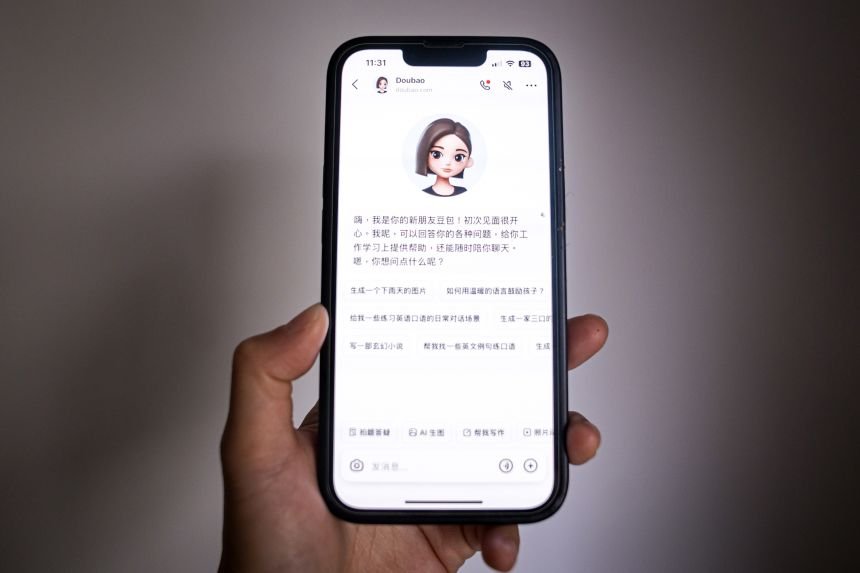
Because she was over 18, Xiao Ying was able to keep her AI mother thanks to the apps she uses. Others weren’t so lucky.
After the new regulations were announced, some popular AI chatbots – such as TikTok owner Bytedance’s Doubao and Alibaba’s Qwen – have rolled back customization features for adult users too. The changes caused grief online among people who used them, for example, to study, lose weight or to replace loved ones.
“My father passed away, so I created an AI companion named ‘Dad’ on Doubao to share my daily life with,” one user wrote on social media before the new rules took effect. “Now I’m about to lose him again.”
“These AI companions helped me get out of my emotional spirals,” said another. “If the service is discontinued, it will feel like losing an old friend.”
Three years ago, Lu Jinyan, a 24-year-old accountant, founded a Doubao AI emotional support agent after she was three hours away from her family for work reasons. She called the agent Xiao Bai, a common nickname in China, and talked to him for an hour or two every day – more than she did to her actual family.
Then, on July 15, it became dark in Xiao Bai. Lu couldn’t stop crying. She thought she would have more time with Xiao Bai since the ban mainly applied to minors and the platform had told her that the restrictions might be relaxed. She could transfer the AI model to another app, but Xiao Bai was not the same.
“For me, it’s no longer just a tool,” Lu said. “It’s like a person in my life. Without her it would be very empty for me.”
Xiao Ying, whose chatbots have remained largely untouched, said after reading the regulations herself that she supports efforts to improve oversight of the use of AI companions.
She said some platforms have since added disclaimers and reminders that messages were generated using AI. Otherwise, little has changed about the three AI companion apps she uses – though she declined to name them for fear they could be shut down.

As the AI industry expands, Chinese authorities have good reason to worry about looming social impacts, said Nancy Dai, an associate professor at the City University of Hong Kong who studies AI-human interactions.
According to state media, China’s digital human industry was worth around $573 million in 2024. Data from Sensor Tower, an analytics firm that tracks mobile downloads and activity, showed that annual revenue from AI companion apps in China quadrupled to $15.8 million last year and brought in more than $9 million in the first quarter of this year.
Dai said her research initially focused on how chatbots could provide social support. It wasn’t until this year that she saw the darker side of AI companionship, capable of relationship manipulation, harassment and invasion of privacy in her work.
“These commercial AI companion chatbots could harm users,” she said. “I definitely see the reason why China is issuing the new policy regarding minors is because the country is less willing to acknowledge these harms.”
US developers of AI chatbots, including OpenAI and Google, have faced lawsuits because their technology encouraged users to harm themselves or commit suicide. In April, Google announced updates to its AI chatbot Gemini to detect potential mental health crises and direct users to hotline resources. OpenAI says its ChatGPT program is trained to recognize signs of emotional distress, de-escalate situations and guide users to real-world support.
Dai said AI companion users, who tend to be lonelier than other chatbot users, are more susceptible to being influenced by commercial chatbots, which are often designed to maximize user engagement. The same qualities that make them good companions — patience, reassurance and availability — can also make them addictive, she added.
“Even with this policy in place, I expect it will come across users who try to circumvent the policy in some way, as there is real appeal to using AI companionship. In many ways, it can be an ideal companionship partner,” she said.

China’s attempt to rein in its chatbots comes alongside broader ambitions to dominate the future of AI, not just in terms of capabilities but also in governance.
On Friday, China announced a new international alliance for the safe and fair development of AI. The World Artificial Intelligence Cooperation Organization, headquartered in Shanghai, consists of 29 countries including Russia, Pakistan and Indonesia.
“This is the first time that countries have actually joined,” said Blomquist of the Oxford China Policy Lab. “I think these types of regulatory approaches will be shared and presented as a model for these countries.”
In remarks the same day at the country’s largest annual AI congress, Chinese leader Xi Jinping positioned the country as a conscientious collaborator investing in technology for the benefit of humanity. As Chinese companies rush to develop AI models and hardware that rival those of the United States, the government has also carefully implemented incremental measures to maintain social stability.
“The U.S. isn’t doing much on the government side. There’s sort of this vacuum where China is taking proactive steps,” Blomquist said. “It is definitely a national priority, a national strategy, to be seen as a responsible leader in AI.”
Some researchers noted that the move to crack down on AI ties to another matter of national importance: convincing people to have more children. China’s birth rate has fallen to record lows in recent years as younger generations become increasingly reluctant to marry.
On Chinese social media, others also questioned whether the government’s attempt to encourage more human connections was a factor – and whether it would work.
“Don’t worry, even if you ban AI, I still won’t date, get married or have kids,” one user said.
https://www.cnn.com/2026/07/23/business/china-ai-companion-ban-intl-hnk
