

For centuries, waging war meant using equipment such as tanks, aircraft, artillery, and weapons, built by a handful of prime contractors under long-term government programs.
It also meant deploying ground troops.
This paradigm is not going away, but software is becoming increasingly central to it. And now more soldiers are fighting wars through a screen.
The military AI industry now includes everything from cloud computing to autonomous drones and decision-making software. This shift dates back to the U.S. drone program of the 2000s and 2010s, which made remote, on-screen killing a feature of warfare.
Billions of dollars are flowing into a handful of companies that are now leading the military’s AI transformation as the old military-industrial complex transforms into a military-technical complex.
As part of a series on AI and warfare, Al Jazeera examines who some of these companies are.
Table of Contents
Who are these companies?
On July 10, Britain’s Ministry of Defense signed a 15-year, 2 billion pound ($2.7 billion) contract with Omnia Training, a consortium led by Raytheon UK, to train 60,000 soldiers annually in the use of AI to build a “combat-ready” British military.
A few days earlier, NATO awarded contracts to operate the alliance’s Enhanced Air Command and Control Data Platform to the US military technology company Anduril for its AI software Lattice, together with the US company Palantir and the French military technology joint venture Athea SAS.
Lattice uses AI and computer vision to combine data from multiple sources into a live image.
AI defense procurement is nothing new. The Pentagon’s 2014 Third Offset Strategy explicitly bet that AI will define the next generation of warfare, but the pace appears to be accelerating as global military spending rose to $2.88 trillion in 2025 and governments poured record amounts into defense budgets.

The Pentagon’s latest major deal saw it sign contracts with eight of the world’s leading technology companies to use AI in secret networks to become an “AI-first” military.
As wars rage from Ukraine to the Middle East, deals like these are multiplying quickly, and the industry itself is evolving just as quickly – traditional defense companies and new entrants alike are competing for a slice of the market. One way to understand this changing landscape is to examine where companies are based on their business models.
Researchers at the Stockholm International Peace Research Institute (SIPRI) have mapped the AI military industry and divided companies into four categories based on their role in the industry:
- Defense primates: traditional defense companies
- Neoprimes or defense startups: newer companies that specialize in software for the military industry
- Big Tech: Technology giants that have massive cloud/computing capabilities
- Foundational Model Providers: Pioneer AI labs developing advanced AI models
Below we explain what the individual companies achieve according to SIPRI’s analysis and which companies are represented in the individual categories.

Secretary of Defense/Contractor
These are the long-established weapons manufacturers that have been supplying the military with systems and hardware for decades and are now layering AI onto these existing systems.
The largest of these companies include Lockheed Martin Corp, RTX, Northrop Grumman Corp, BAE Systems and General Dynamics Corp, all of which hit all-time highs after the start of the US-Israeli war against Iran.
Part of this rally reflects how deeply AI has now become integrated into the product lines of these legacy arms companies. In February, Lockheed Martin said it was flight-testing an AI tool for its F-35 fighter jets to help pilots more quickly identify enemy aircraft. L3Harris, another American defense company, has integrated AI directly into its camera systems to enable real-time targeting. It is also equipped with platforms like Shield AI’s tracker, which helps detect enemy drones. Shield AI is a US defense technology company that develops autonomous AI pilots for military aircraft and drones.

Neoprimes or defense startups
This newer category, sometimes referred to as “neoprimes,” are software companies that sell specialized data products to the arms market, as well as to police and border patrol forces.
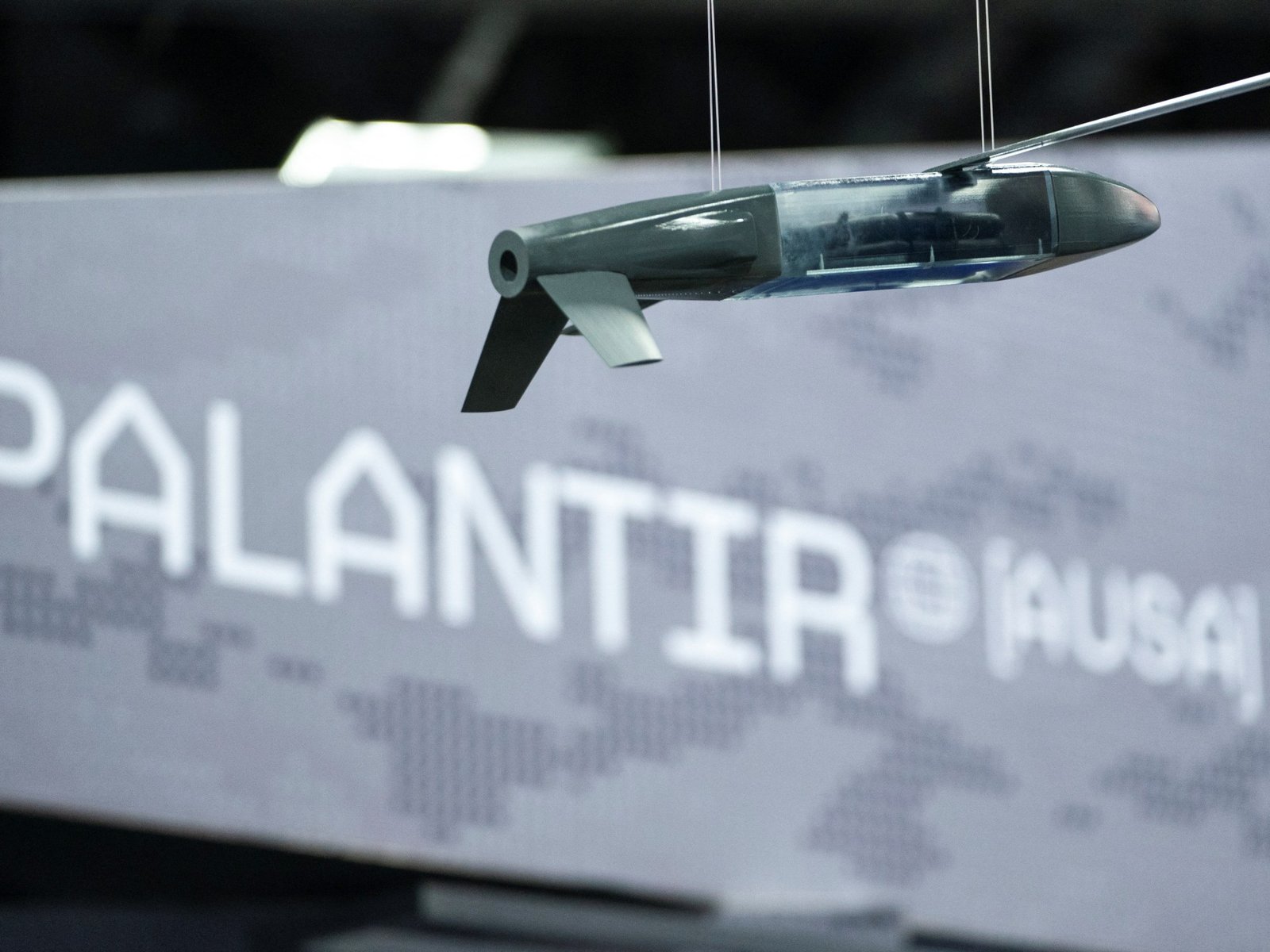
Palantir is perhaps the best-known name among these companies, largely due to its role in Project Maven, the Pentagon’s flagship military AI program. Designed to accelerate combat decision-making, it relies on AI and machine learning to automatically search satellite imagery, drone video and signals information to identify and prioritize targets.
The system is used in various conflicts, including the Ukraine War and the US-Israel war against Iran – Maven identified 1,000 targets in the first 24 hours of the latter conflict.
A direct competitor to Maven is Anduril’s Lattice platform, which integrates its own hardware – drones, sensor towers, autonomous vehicles – into a single command network and is heavily used by the US Army.
 Anduril will unveil its Fury unmanned combat aircraft at the Farnborough International Airshow in Hampshire, UK, on July 20, 2026 [Cassell Bryan-Low/Reuters]
Great technology
Companies like Google, Meta and Amazon Web Services (AWS), which control around 67 percent of the global cloud infrastructure market, are increasingly tied to military applications that traditional defense contractors provide.
In May, the US Department of Defense announced a new agreement with eight technology and AI companies to use their technologies for its secret networks.
The agreements with SpaceX, OpenAI, Google, NVIDIA, Reflection, Microsoft, Oracle and AWS were negotiated to “accelerate the shift toward establishing the U.S. military as an AI-focused force.”
The deal means these companies have been cleared for IL6 and IL7 networks, the most sensitive and secret computing environments the Defense Department operates.

Provider of basic models
The final category are companies that develop the underlying AI models that other companies integrate into military tools, such as OpenAI and Anthropic in the US and Mistral AI in Europe. Chinese researchers have been developing AI models for military purposes since the early 2020s, using, among other things, Meta’s Llama model as the basis for the People’s Liberation Army (PLA) tool called ChatBIT, which is intended to collect information and support local decision-making, according to Reuters.
The Pentagon estimated China’s spending on military AI at about $1.5 billion to $2 billion per year, comparable to American figures.
According to Reuters, the Pentagon this year added Alibaba, Baidu, BYD, NIO, RoboSense and Unitree to its list of Chinese military companies. According to the Pentagon, these companies are intended to support the military in China.
Smaller Chinese AI firms affiliated with former employees of Baidu, Alibaba and Tencent have developed targeting, surveillance and decision-making tools for the military, according to a 2021 report from the Center for Security and Emerging Technology (CSET).
Many of these frontier artificial intelligence laboratories were opposed to the use of their products in the military; However, in 2024, OpenAI lifted its ban on military use, and that same year Palantir and Anthropic entered into a partnership that is now rife with litigation over how Claude was used by the US military.
https://www.aljazeera.com/news/2026/7/27/the-ai-military-complex-which-are-the-main-companies-in-it
