

Given Anthropic’s growth rate and valuation, our jaws drop. But sometimes we lose sight of how big it already is…compared to everyone else in the software industry.
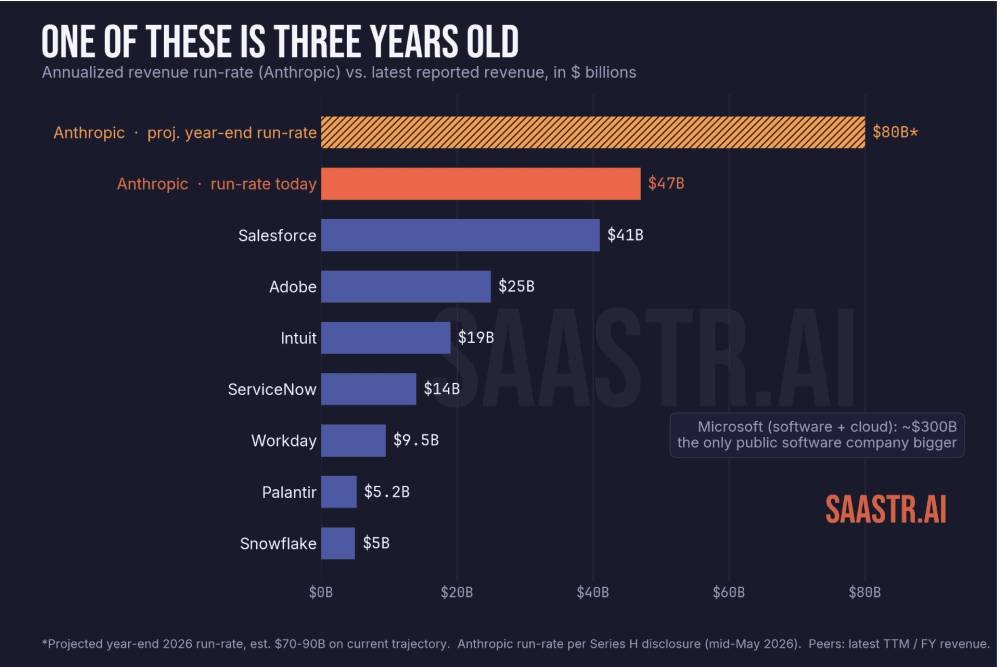
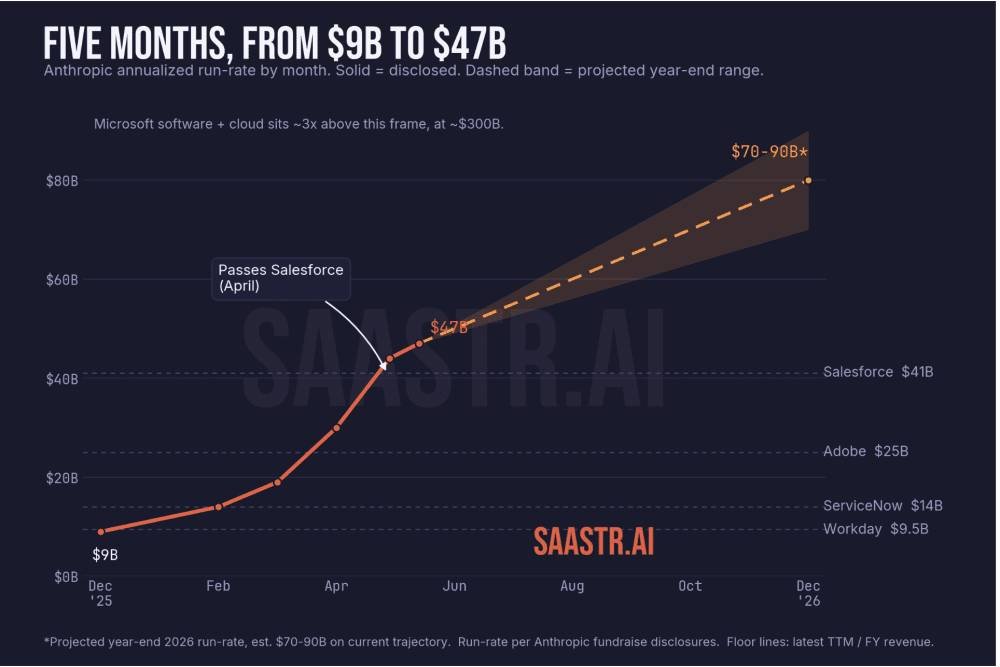
Anthropic ended 2025 with ongoing revenue of around $9 billion. In February 2026 it was $14 billion. Then $19 billion in March, $30 billion in April, $44 billion in early May and $47 billion by mid-May, disclosed along with the Series H. That’s the annualized run rate, last month multiplied by twelve, and Anthropic has reported it in fundraising announcements, which it would be securities fraud to understate or exaggerate.
When you compare this $47 billion to public software competitions, the picture quickly becomes uncomfortable.
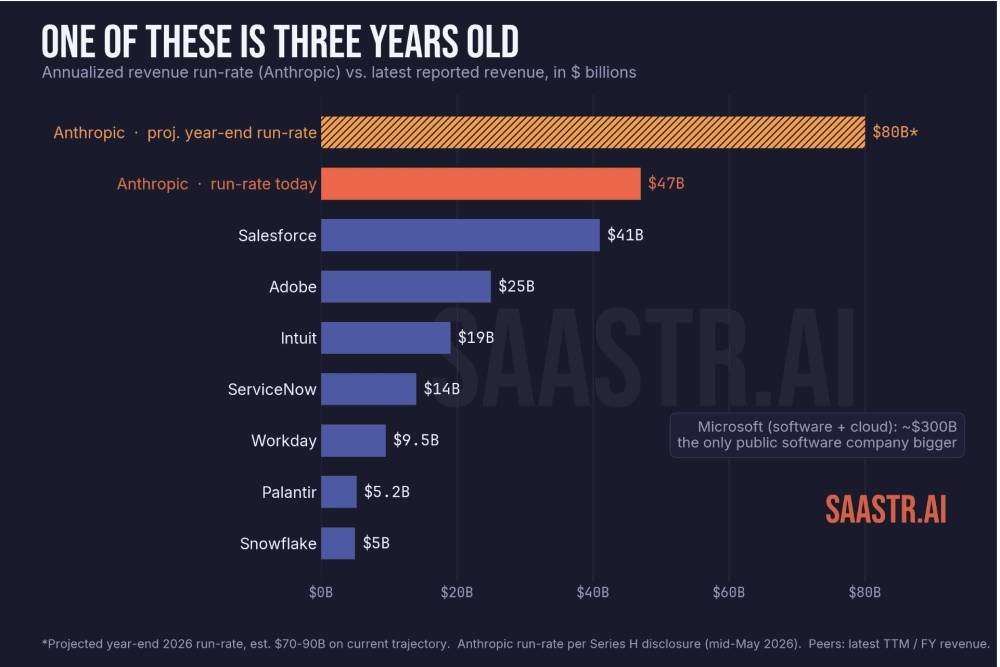
Table of Contents
The only one bigger is Microsoft
Salesforce, the largest pure-play software company in the world, generates sales of around $41 billion. Anthropic’s run rate exceeded this in April. Adobe is worth around $25 billion. Intuit about $19 billion. ServiceNow about $14 billion. Working day about 9.5 billion US dollars. Anthropic is already bigger than everyone else, three years after its first dollar in sales.
On the current path, the run rate is moving to $70 billion to $90 billion by December. At this level, there is exactly one listed software company that is still ahead: Microsoft, whose software and cloud business is worth around $300 billion.
That’s the headline, and it’s true, but only if you know exactly the two companies that look like exceptions.
Oracle and IBM are not the counterexamples they seem to be
Oracle just reported $67.4 billion for fiscal 2026 and forecast $90 billion for fiscal 2027. On the face of it, it’s a second company bigger than Anthropic’s year-end earnings, at least for now. If you take it apart, it’s no longer there. Oracle’s actual software line was $24.5 billion, shrinking 1% last year. The growth is $34 billion in cloud revenue, with the majority of that coming from renting GPUs to AI labs as well as services and hardware. Oracle is now a landlord of AI data centers with an attached database.
IBM has the same shape: a roughly $60 billion company focused primarily on consulting and infrastructure, with a software segment of about $30 billion.
On a software-versus-software basis, both are below Anthropic. Microsoft is the only publicly traded company whose software business earns more than a three-year-old startup.
Anthropic will soon be larger than all pure software companies. Together.
Anthropic is no bigger than all the others combined. But it’s on the right track.
If you add up the purely public software universe, you get $200 billion. Salesforce, Adobe, Intuit, ServiceNow and Workday alone total over $100 billion. The rest of the field is at the top, with more than 60 names from Atlassian and CrowdStrike in the long tail, and Anthropic, with a year-end run rate of $70 billion to $90 billion, is less than half the total.
Take the ten next-generation software names investors are watching: Palantir, Snowflake, CrowdStrike, Datadog, Zscaler, Okta, HubSpot, MongoDB, Cloudflare and Confluent. Their total revenue is around $33 billion. Anthropic’s success rate is now higher than all ten companies combined. Palantir, with revenue of $5.2 billion, and Snowflake, with $5.0 billion, are the two largest on this list, and Anthropic has added more than a full Palantir to its revenue in just a few weeks.
This comparison is what matters. Not a single incumbent. A decade of venture capital-backed software winners, stacked together, smaller than a company that made its first dollar in 2023.
It’s not a classic “ARR,” but who cares?
Two caveats, because the post is worthless if a CFO can pick it apart in the comments.
First, run rate is not annual revenue. The $47 billion is a strong month on an annualized basis. The public comparisons mentioned above are actual values from the last twelve months. Based on actual revenue in calendar year 2026, Anthropic will generate about $20 billion to $26 billion this year, putting the company in the top five in the software industry rather than second. The run rate at the end of the year tells you where the journey is headed. Trailing revenue is where it was. Both are real and the gap between them is the entire point of an exponential function.
Second, Anthropic records a significant portion of gross revenue. Sales through AWS, Google, and Microsoft are counted as full end-customer spend, with the partner cut recorded as a cost. This increases sales compared to a B2B company with net reports. It doesn’t change development, but it does mean that run rate and a clean subscription number are not the same thing.
None of these reservations affect the core result. They think it is justifiable.
For this reason, many VCs are currently finding it difficult to get excited about a lot of B2B software
The reason this is important is not so you can brag about having an AI lab. This is what the comparison says about how software is paid for.
Anthropic didn’t get here by selling seats. Token sales occurred, and a single developer running an agent against a real codebase consumes a rate never modeled in a per-seat plan. Claude Code alone went from zero to $2.5 billion in about nine months, making it larger than most companies in this table, built by a product team, and priced solely based on consumption.
With a few exceptions, the public software names below Anthropic are seat-based companies. The market has already begun to revalue them, with the public software multiple at a more than decade low. The revenue gap is key. When the fastest-scaling software company in history monetizes work rather than signups, any roadmap based on counting users now competes with a pay-for-performance model.
The question for founders is not whether Anthropic’s run rate is real. It’s about whether your pricing will hold up in a market where the largest new software company in the world has never sold a seat.
https://www.saastr.com/by-year-end-anthropic-will-out-earn-every-public-software-company-except-microsoft/
