

By Ross Arnold, Maj. Johnathon Hardin, Marc Federico, Julia Gustafson, Christopher Fuller, David Bowlby
PICATINNY ARSENAL, NJ – The U.S. Army Combat Capabilities Development Command (DEVCOM) Armament Center has become the hub for cutting-edge, safety-critical software systems that provide U.S. Soldiers with battlefield advantages.
While the Armaments Center is synonymous with the development of weapons and ammunition hardware that form the lethal backbone of the U.S. Army, its software operates invisibly at a critical juncture where soldiers and complex systems provide battle coordination, advanced command and control functions, and precise fire control that safely delivers modern firepower.
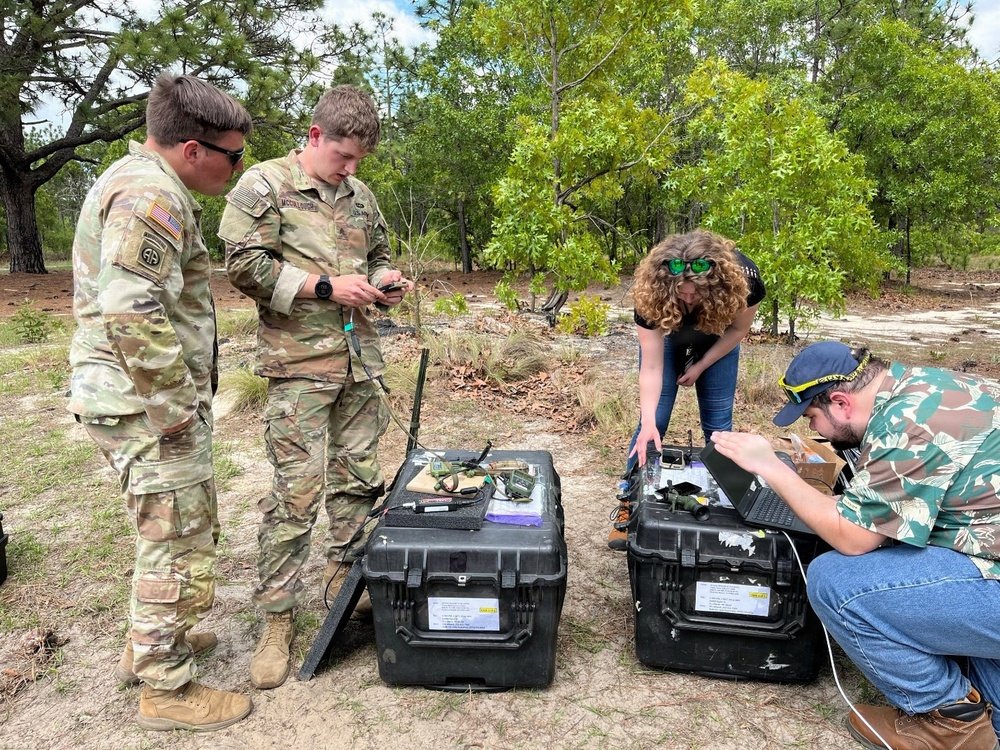
Be it operating a portable mortar ballistics computer, creating fires with the advanced Artillery Execution Suite (AXS), or entering precise fire missions with the Excalibur portable fire control system, Soldiers routinely execute complex military missions quickly, accurately and safely using software developed by the Armaments Center.
Writing code that runs lethal systems cultivates a culture with a fundamentalist focus on safety and quality. This was confirmed in January when the Armaments Center received its second Rear Admiral Grace M. Hopper Award for Software Maintenance, becoming the only Army organization for nearly two decades to be rated at a Level 5 maturity on the CMMI Institute’s Capability Maturity Model Integration Development scale.
Recently, Armament Center Director Chris Grassano signed the “Armament Center Modern Software Engineering Policy,” which provides for the use of modern software development tools and techniques. This includes agile software development and the architecture of the Modular Open Systems Approach (MOSA), as well as workflows and tools for Continuous Integration/Continuous Development (CI/CD) and DevSecOps, which are aligned with the latest state of the art in this area.
Agile software development has experienced growing influence since 17 software practitioners published a manifesto in 2001 emphasizing values such as constant collaboration, early and continuous delivery of software, working directly with customers, accommodating changes in requirements, and favoring software delivery over documentation. It is now widely considered the industry standard model for the software development life cycle.
Based on best practices and agile principles used in AXS development, the Mortars Software Development Team took the lead and worked to modernize legacy mortar fire control software for mounted and dismounted units. The team developed the Common Fire Control Framework, a modular, flexible software architecture that can adapt to changing needs and which enabled the creation of the Mortars app. These initiatives met with great success at the U.S. Department of Defense’s Weapon Systems Software Summit.
In addition, the Mortars team identified opportunities to modernize external processes that had historically slowed delivery to the fighter jet. They created a new Standard Operating Procedure (SOP) to integrate Army Interoperability Certification (AIC) testing into software development.
Previously, an external agency had conducted AIC testing, which increased scheduling and costs. By leveraging integrated test teams and incorporating interoperability testing into planned test events, the new SOP reduced risks, costs and delivery times.
Agile-based success can also be found in the AXS development team. AXS is software that helps streamline artillery operations and provides a more user-friendly and adaptable platform compared to its predecessor, the Advanced Field Artillery Tactical Data System.
The AXS team combines government leadership and industry expertise to deliver secure, high-quality software to the Capability Program Executive Office for Command, Control, Communications and Network. Using the Scaled Agile Framework, the AXS team delivers capabilities in three-month increments while meeting the Army Capability Manager’s requirements for fire cells and targeting. Through continuous integration, continuous delivery of automated testing, and extensive systems knowledge, the team has supported live-fire experiments with large artillery platforms.
This government-led agile approach enables the team to respond to executive priorities on the fly, without the delays of contract changes. This transformative approach comes at an optimal time as the War Department has placed tremendous emphasis on delivering new capabilities at the pace of modernization.
The United States Ballistics Library (USBL), a modern, agilely developed alternative to the NATO Ballistics Kernel, is also at the forefront of the Armament Center’s software modernization efforts. Developed under the leadership of Army Chief Technology Officer Alex Miller, USBL can be deployed as a standalone feature or integrated as a cloud-based microservice. It launched in February 2025 and is well ahead of schedule. Full implementation is planned for this year.
The Armaments Center Software Factory (ACSF) was created to support the need for rapid deployment of weapons systems software such as the United States Ballistics Library, the Artillery Execution Suite, and the Common Fire Control Framework. The ACSF is a collection of people, tools and processes that integrate enterprise tools into continuous integration pipelines to automate the build process, implement cybersecurity scanning early and often, and quickly create working software that meets the needs of the warfighter. ACSF is a unique software factory optimized to deliver secure, high-quality weapon system software.
ACSF integrates enterprise services such as the Army’s DevSecOps organization with GitLab engines, project-specific tools, and custom continuous integration pipelines. This is done in compliance with War Department and Army guidelines, including Army Directive 2024-02, which enables modern software development and procurement practices.
Through initiatives such as CF2, AXS, USBL and ACSF, the Armaments Center strives to redefine security-critical defense software development. The Armaments Center embraces a culture of improvement, embraces agile development and collaborates with industry leaders, delivering secure, reliable and advanced software capabilities and ensuring that U.S. Armed Forces remain dominant on the modern battlefield.
https://www.dvidshub.net/news/569406/armaments-centers-zero-defect-culture-embraces-agile-and-other-modern-software-development-approaches
