

Artificial intelligence has taken over much of what used to be Fabrizio Primerano’s software engineering job. He brainstorms with his colleagues, researches competitors, and writes and tests code.
But Mr. Primerano still has a job, at the German software giant SAP. It involves fewer routine tasks and more of what feels like managing and supervising AI agents or bots that can be programmed to act like personal assistants and, increasingly, human collaborators.
“It gives me the freedom to do more of this creative work,” Mr. Primerano said recently.
That’s what executives at SAP, Europe’s largest software company by market value, want. SAP, long considered a stoic provider of back-office products, says it is taking a “lean-in” approach to technology that poses an existential threat to its programmers and business model.
Those responsible admit that AI makes many of the tasks that software engineers did until recently superfluous for humans. In a round of restructuring two years ago, SAP cut nearly 10,000 jobs, some due to AI, the company said. SAP wouldn’t break down exactly how many of those were AI-related or what type of jobs were eliminated.
To prevent more job cuts, they say they have encouraged workers to invent new, more valuable jobs, aided by the rapidly improving technology available to them. Company officials say that despite the previous restructuring, they have added more than 3,500 new jobs since 2023, including new job titles such as “forward-deployed engineers” or those who work with customers to develop AI-driven solutions.
“I’m not sure whether anyone will still be programming software here in two or three years,” Christian Klein, the managing director, told me in a recent interview. He said he doesn’t expect to operate with a smaller workforce, “but with a very, very different workforce.”
Such a strategy could be a source of hope for Europe, economists say. This could prevent large job losses in some sectors and close unfilled positions in others. Europe, an aging continent that has long faced slow economic growth, suffers from a chronic shortage of skilled workers.
“AI could save us from a very serious labor shortage” caused by Europe’s aging population, Nicola Fuchs-Schündeln, an economist and president of the Berlin Science Center for Social Research (WZB), told me.
It could be difficult for Europe to replicate the SAP approach at scale, if it proves successful at all. Marcel Fratzscher, economist and president of the German Institute for Economic Research, agreed that there was enormous potential to solve Europe’s demographic problems. But only if Europe invests significantly and quickly enough in the technology to catch up with the USA or China. Companies like SAP rely largely on American AI models and a physical and virtual supply chain that runs through Asia and the US.
“Europe is lagging behind in fully adopting AI technologies,” said Fratzscher, “because it lacks good digital infrastructure. It lacks the necessary skills.”
Some analysts say SAP’s AI strategy is shaky because the company continues to rely heavily on American AI models. The Trump administration decided last month to bar foreigners from using two of these models from the company Anthropic. Although the government recently reversed course and lifted restrictions, the move had rung alarm bells for SAP and its customers.
SAP’s AI strategy is “rooted in a geopolitical fault line,” wrote Peter M. Färbinger, editor-in-chief of E3 Magazine, which covers the company extensively, last month. “The risks for existing SAP customers are blatant.”
Investors were pessimistic that AI will be a boon for SAP. Over the past year, the company’s share price has fallen by almost 50 percent, even though sales and profits have increased during this time. Other organizations, like financial technology company Block, say they are saving money by laying off employees as their AI agents become more sophisticated. And analysts worry that AI models are so good at writing software that customers will no longer need SAP to create programs to manage billing or supply chains.
But the company is trying to follow this trend.
During two recent visits to SAP headquarters in Walldorf, Germany, on a sprawling campus overlooking asparagus fields, employees and executives spent hours telling me how AI has transformed their jobs and the services they offer their customers. (When I returned to Berlin, I used an AI software program provided by The New York Times to search these conversations.)
SAP employees are using AI tools to improve patent applications and handle some customer support requests. Its AI agents program prototypes for new software or add new features to existing programs, thereby accelerating the product development process.
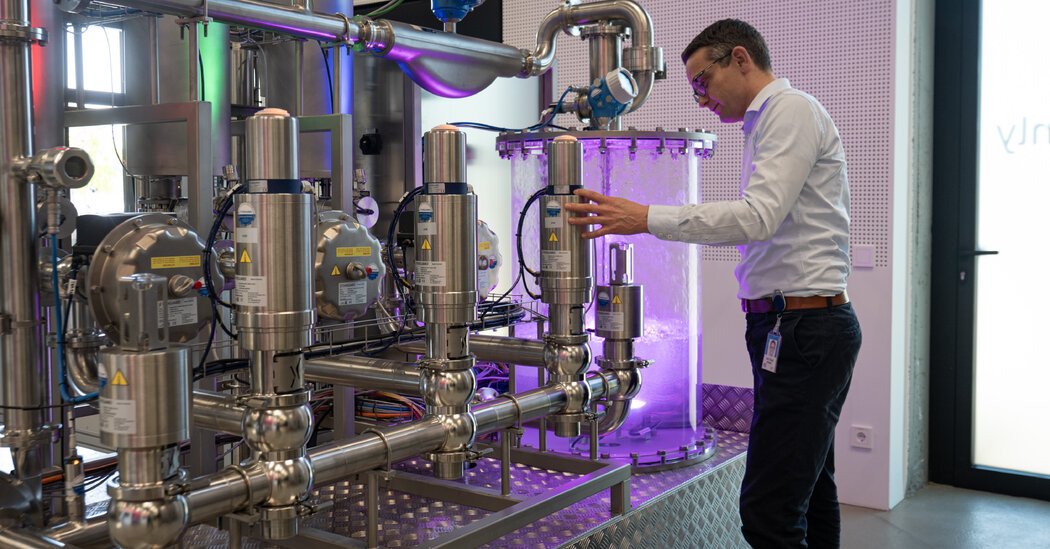
To help customers understand how all of these agents could help their business, the company has built de facto AI demonstration centers, including a mock factory floor, to demonstrate the power of AI to improve tool making or beer brewing.
Matthias Deindl, SAP product management lead, said AI agents would ultimately help factories retain and automate knowledge that would have been lost as skilled workers retired, such as knowing which gear to adjust when a machine makes a certain unsettling noise.
Many companies across Germany and elsewhere in Europe need such a breakthrough. The Organization for Economic Cooperation and Development estimates that Germany will lose nearly seven million workers, or about 13 percent of its working-age population, over the next decade due to an accelerating wave of retirements.
Without a politically sensitive increase in high-skilled immigrants, AI offers a lifeline. However, according to a recent study on which Ms. Fuchs-Schündeln worked, European companies are slower than American competitors in researching its possible uses.
“AI could make companies much more productive,” she said. “But it’s really important that they use it.”
Germany has one of the best AI adoption rates in Europe, even in some unlikely places. I recently spent a morning with the analytics staff at TSG 1899 Hoffenheim, a top German soccer team sponsored by SAP. The team uses AI-powered SAP software to scout rivals and select tactics for upcoming games.
The software helps create player development plans and provides specific guidance, such as whether a midfielder should cut left or right in a given situation when receiving a pass.
AI tools give the team “a perspective that we didn’t have before,” Timo Gross, chief analyst at TSG Hoffenheim, told me.
But, he added, it is only a complementary tool for human coaches and not a replacement for their intuition, especially when it comes to dealing with players and their emotions.
Economists are still debating whether AI will save more jobs than it replaces across industries. At SAP there is evidence of both.
Jan Portisch, an SAP development manager, told me a story from a conference in Houston this spring. While watching an auto executive discuss a business problem, Mr. Portisch pulled out his phone and tried something: He took a photo of the presentation, uploaded it to an AI agent, and asked the agent how SAP’s software could solve the problem.
The agent found a solution. A marketing pitch deck was then created over the phone by Mr. Portisch. It was finished in time for Mr. Portisch to show the manager as he left the stage.
The interaction showed how AI can help employees be more productive, but also raised the question: If AI can help software developers make sales calls, what’s stopping it from completely replacing many sales jobs?
SAP bet on that. It is expanding its Walldorf campus with a new, ultra-modern office building. Mr Klein, the chief executive, described this as a sign of the company’s confidence that its workforce would not shrink in the future.
Mr. Klein has a 9-year-old son. “Probably two years ago I would have told him, ‘Oh, become a computer engineer,'” he said. “I’m not so sure I would advise that anymore.”
Instead, he said he would guide his son toward a career that deals directly with customers, supported by AI-powered work.
Either that, he said with a grin, or professional football.

Jim Tankersley
reporter
Two of the world’s biggest economic stories are currently colliding in Germany. The first is demographic: a massive wave of retirements is causing companies to panic about a looming labor shortage. The second is technological: artificial intelligence is ready to automate large parts of office work. In my reporting, these trends are almost always portrayed as a double threat. But at a large German company, SAP, I heard a completely different story.

https://www.nytimes.com/2026/07/02/world/europe/germany-sap-ai-jobs-skilled-workers.html
